
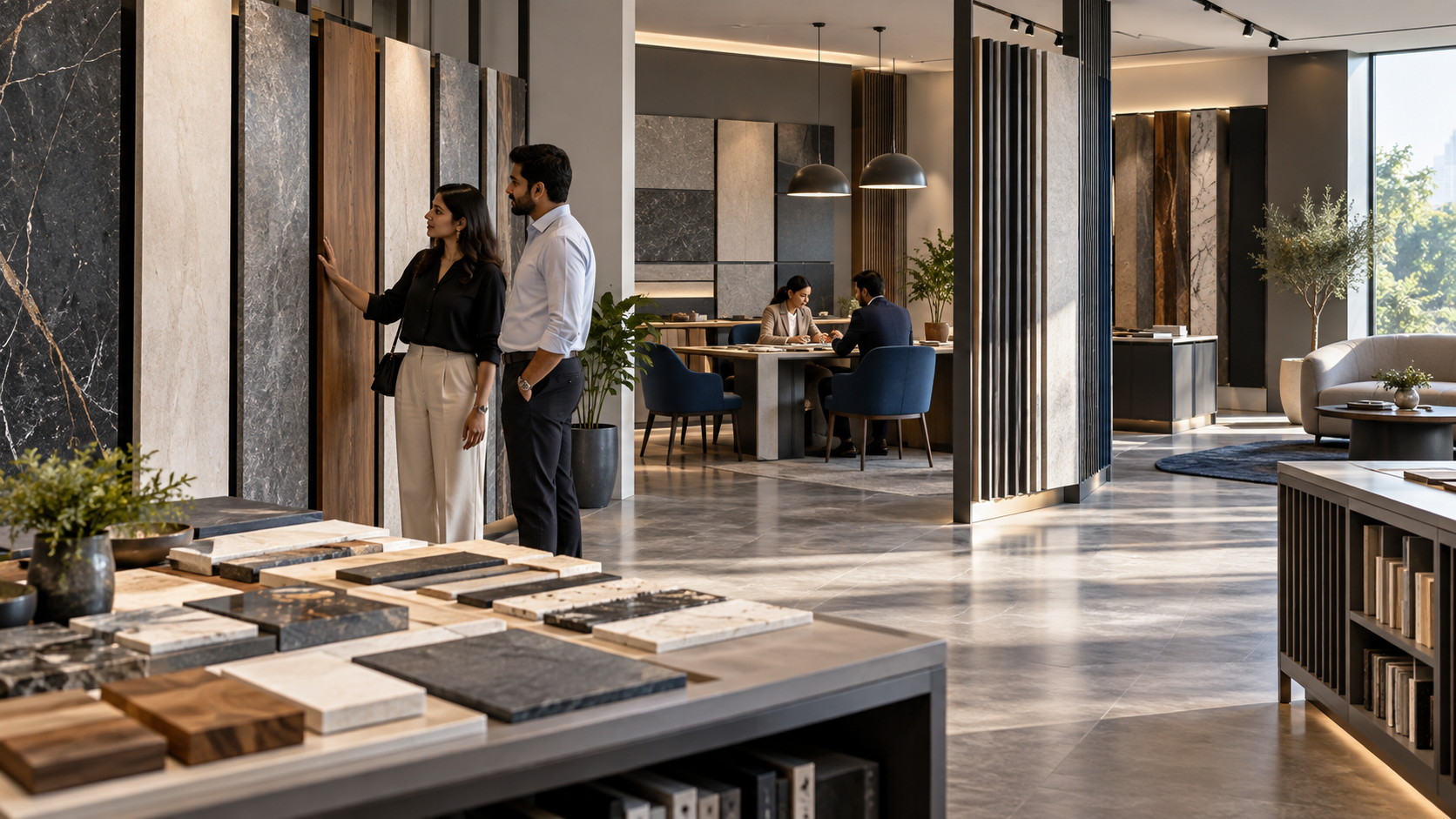
A material showroom should make selection feel clear, not crowded. The strongest displays organise products by application, present samples at a useful scale and give visitors enough context to imagine the finish in a real project.
Organise around customer decisions
Visitors rarely begin with a product code. They arrive with a wall, facade, sign, floor or furniture application in mind. Grouping samples around these decisions creates a more natural journey and helps the sales team explain related options without overwhelming the customer.
Create distinct zones for acrylic and signage materials, decorative wall surfaces, louvers, flooring and lighting components. Within each zone, move from a strong application image to physical samples and then to technical or availability information.
Show materials at more than one scale
Small chips are useful for comparing shades, but larger panels reveal pattern, reflectivity, groove spacing and overall visual character. Use a combination of labelled hand samples, medium display panels and one or two full application mock-ups.
For acrylic, include polished edge details and examples of solid colour, opal diffusion and relevant fabrication. For fluted panels and louvers, show how profiles meet at corners and terminations. For laminates and Polygranite sheets, present enough surface area for the customer to understand the pattern.
Create a consistent labelling system
Every display should identify the brand, product family, shade or reference and the best next action. Keep labels short and positioned consistently. A QR code or catalogue request can support additional information, but the physical label should remain understandable on its own.
Use the actual brand identity for each range. WALCAST, WALGLAS, OPTIGLAS, CPB and TAIKO should remain visually distinct while the showroom itself is clearly presented by Crystal Polycast.
Use light to reveal the material
General showroom lighting should be even and comfortable. Add focused lighting only where it helps reveal texture, depth or a polished edge. Illuminated acrylic and LED demonstrations deserve a dedicated controlled area so visitors can compare the unlit and illuminated appearance.
Avoid placing all glossy samples directly opposite strong windows. Controlled viewing angles make reflections easier to understand and keep labels readable.
Build in flexibility
Product ranges and popular finishes evolve, so display systems should be easy to update. Removable panels, sample rails and modular shelves allow new references to be introduced without rebuilding the entire showroom. Keep frequently handled samples within reach and reserve higher positions for brand communication or complete application imagery.
Connect the display to a useful conversation
A showroom works best when the physical presentation and sales process support each other. Provide a simple enquiry sheet for application, dimensions, preferred finish, quantity, project city and timeline. This information helps the team move from inspiration to current availability and sampling.
Crystal Polycast works with dealers, distributors, architects, interior designers, fabricators, contractors and retailers across India. Visit the product overview to see how the material families can be organised for a showroom or project discussion.